
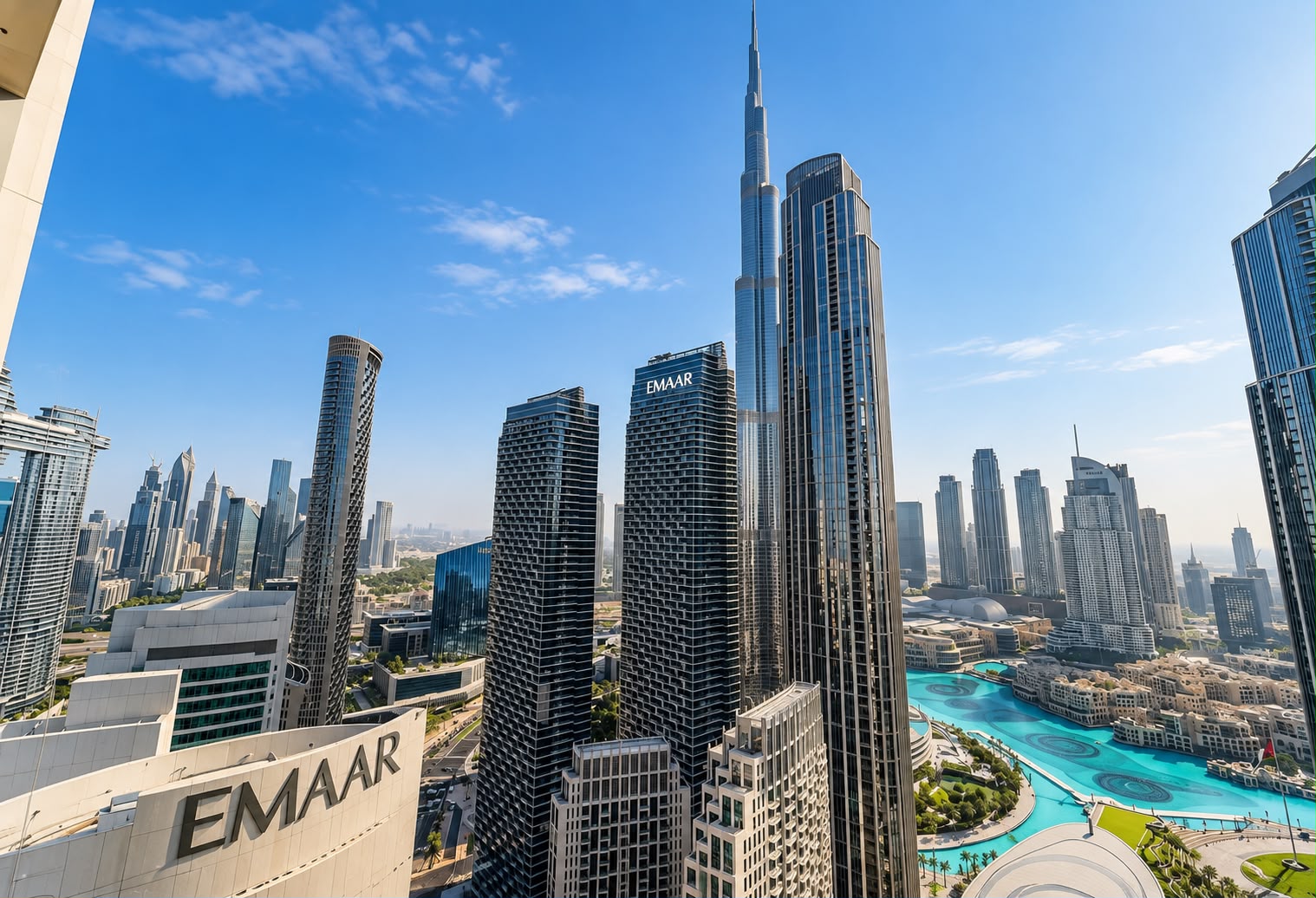
Why Dubai property is attractive to international investors
The UAE tax environment is the most immediately obvious advantage. There is no capital gains tax, no annual wealth or property tax, and no income tax on rental proceeds in the UAE — net rental yields are therefore broadly equivalent to gross yields, after deducting service charges and property management costs.
This contrasts sharply with the UK, where rental income is taxed at marginal income tax rates (20–45%) and residential property capital gains are taxed at 18–24%. A UK landlord achieving 5% gross yield may net 2.5–3% after tax. An equivalent Dubai investor receiving 5% gross may net 4–4.5% after service charges and management fees.
Rental yields: what to realistically expect
Studio and one-bedroom apartments in Dubai Marina and Downtown Dubai have consistently achieved gross yields of 6–9% in recent years, driven by strong short and long-term rental demand. In Jumeirah Golf Estates, villa yields are lower — typically 3.5–5.5% gross — but capital appreciation potential is higher, particularly for well-renovated properties with golf-course views.
Yields vary materially by unit. A higher-floor apartment with a direct Burj Khalifa view in a branded residence commands a different rent-to-capital ratio than a comparable unit without the view. Comparing community averages provides limited insight — comparing specific unit types, positions and specifications provides a far more accurate basis for an investment decision.
Where does genuine value sit in 2026?
Prime community prices in Dubai have risen significantly since 2020, driven by strong inbound migration and limited supply of quality product in established neighbourhoods. Headline price comparisons can therefore give a misleading impression of current entry points.
However, certain segments continue to offer genuine value relative to the surrounding market. Renovation-opportunity villas in Jumeirah Golf Estates — where an unrenovated property can be acquired at a material discount to nearby renovated equivalents — represent one such opportunity. Motivated seller situations, where pricing circumstances rather than market weakness create a below-market entry point, represent another.
The key discipline is comparing like with like: the same cluster, the same course, the same view category. Not community-level averages.
Risks to consider honestly
Dubai's property market has historically been more volatile than London or New York, with sharp correction cycles in 2008–2009 and 2014–2016. Regulation has strengthened considerably since then, but the market remains more susceptible to global capital flow changes, oil price sentiment and geopolitical events than more mature markets.
Currency risk is a real consideration for sterling-denominated buyers: the dirham is pegged to the US dollar, so British investors face USD/GBP exposure on both purchase and sale. Resale liquidity varies significantly by community: established areas such as JGE, Marina and Downtown have deep markets; newer peripheral developments can be significantly harder to exit.
Off-plan risk deserves particular attention. Developer completion delays and specification changes are common in Dubai's off-plan market. Buyers purchasing off-plan should conduct careful due diligence on the developer's track record.